Uniting otherwise polarized and acrimonious Catholics across the spectrum of opinion is no mean accomplishment, but U.S. President Donald Trump succeeded in that earlier this week, at least momentarily (and with notable exception).
—
Catholics in the U.S. and around the world, from Pope Leo XIV to the last would-be pundit on social media, united early this week in opposition to U.S. President Donald Trump’s most recent round of threats.
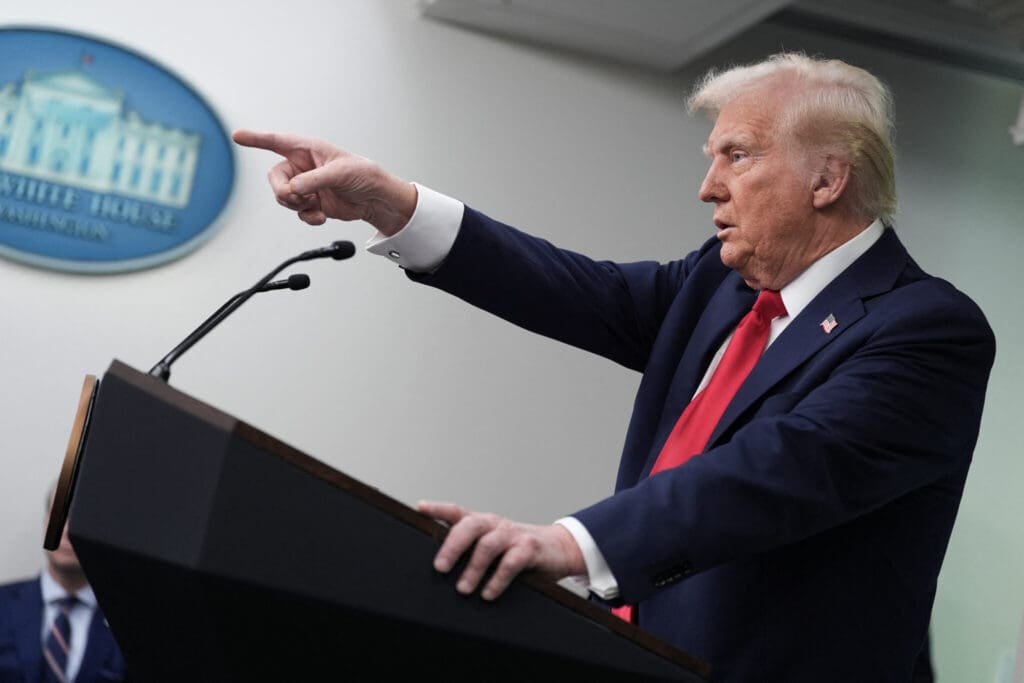
Trump has relented – for now – after threatening to unleash a bombing campaign against the whole of Iran’s power and transportation infrastructure, acts that experts in the law of war in the U.S. and around the world characterized as criminal.
“He’s both threatening a war crime and he’s engaging in a war crime through that rhetoric itself,” retired U.S.A.F. Lt. Col. Rachel VanLandingham told PBS on Monday, hours before Trump doubled down on his threat in a message he shared via his Truth Social platform.
“[T]he law of war, that’s not just international law. It’s U.S. law,” VanLandingham said, “and our military members are deeply trained and steeped in this law.”
“The law of war prohibits measures of intimidation against a civilian population, including threats of violence whose primary purpose is to sow terror amongst that civilian population,” the Air Force officer explained.
Early Tuesday morning, Trump said, “A whole civilization will die tonight, never to be brought back again.”
By the time it was Tuesday afternoon in the U.S. capital – evening in Rome – Pope Leo XIV had weighed in, calling the U.S. president’s threats “immoral” and “unacceptable” and noting that “many have called [Trump’s campaign] and unjust war.”
RELATED: Pope calls Trump threat against Iran ‘unacceptable, immoral’, Trump relents for now
Leo explicitly noted that “attacks on civilian infrastructure [are] against international law” and renewed his appeals for immediate cessation of hostilities.
Hours later, Trump announced a two-week ceasefire.
To assert a causal connection between the developments would be a fairly egregious case of what’s known as the Post hoc, ergo propter hoc fallacy. It’s a mistake to suppose that one event caused a subsequent event simply because the latter followed the former in fairly quick succession.
That said, the nearly universal Catholic condemnation of Trump’s threats remains something noteworthy.
Uniting otherwise polarized and acrimonious Catholics across the spectrum of opinion is no mean accomplishment, and Trump has succeeded in that, at least.
There are, however, some high-profile Catholic outliers in public life: U.S. Secretary of State Marco Rubio, for one, preferred not to answer a reporter’s direct question regarding the legality of Trump’s threats.
Rubio was posing with New Zealand’s foreign minister Winston Peters, with whom he met Tuesday in Washington, D.C.
U.S. Vice President J.D. Vance – a convert to Catholicism who recently announced a book detailing his journey into the Church – addressed Trump’s ultimatum on Tuesday in remarks to reporters at a press conference in Hungary, where he was campaigning for the country’s archconservative strongman Prime Minister, Viktor Orbán.
“Fundamentally,” Vance said, “what Iran is trying to do – because they’ve been defeated militarily – is they’re trying to extract as much economic pain on the world as possible.”
“And the President of the United States is a man who recognizes leverage,” Vance continued, “that if the Iranians want to exact a certain amount of pain, the United States has the ability to exact much, much greater pain.”
“The president doesn’t want to do that,” Vance said. “I don’t want to do that,” he said. “That’s why we’re negotiating so aggressively,” the U.S. vice president said.
During the press conference – a wide-ranging one well worth careful consideration in all its parts – Vance also fielded a direct question from The Washington Post’s Natalie Allison regarding the Trump administration’s religious rhetoric during the conflict.
“[T]here’s been some rhetoric from this administration, your administration, about this war, God supporting the United States in this war and these strikes against Iran being part of God’s will,” Allison said.
“Do you agree with that?” she asked, “and what do you make of the idea that God is on the side of the U.S. in these strikes?”
Some of the rhetoric to which Allison alluded came late last month from war secretary Pete Hegseth – an evangelical with strong ties to a pastor who has stated his disapproval of public Catholic displays of devotion – who asked God to give U.S. servicemembers “overwhelming violence of action against those who deserve no mercy.”
RELATED: At Pentagon Christian service, Hegseth prays for violence ‘against those who deserve no mercy’
RELATED: Pope opens Holy Week condemning war waged in Jesus’s name
Vance replied that his “attitude towards military conflict has always been to pray that we are on God’s side.”
“My own view is that we are doing this,” i.e. the Iran campaign, “for the right reasons,” Vance also said.
“We’re doing this because we don’t want a regime that is committed acts of terrorism to have the world’s most dangerous weapon, because that would mean a lot of innocent people dead,” the vice president went on to say.
“I certainly hope that God agrees with the decision that Iran shouldn’t have a nuclear weapon,” Vance said, “but I’ll keep praying about it.”
The (non-) responses of Rubio and Vance to reporters’ questions are particularly interesting, not only because both men are Catholics in prominent positions within the Trump administration, but also because they are widely considered to be likely seekers of the GOP presidential candidacy nomination in 2028.
RELATED: Rubio’s speech on US-Europe relations finds parallels in Vatican-NATO relations
As Vance was leaving Hungary on Wednesday after campaigning for Orbán ahead of the country’s Sunday parliamentary elections – itself an unusual step for a U.S. political leader in a foreign country, one made more so by accusations Vance levied against the European Union of “foreign election interference” in Hungarian electoral affairs – he also forgot who the papal ambassador to the U.S. was.
Asked by a News Nation reporter about a piece from The Free Press earlier this week claiming Pentagon officials in January tried to strong-arm the papal nuncio, Cardinal Christophe Pierre, into support for U.S. military adventures, Vance first claimed he was unfamiliar with the story, and did not recognize Pierre’s name when the reporter said it.
“Brought who?” Vance said. “Cardinal Christophe Pierre,” the reporter repeated, explaining that the report claimed senior War Department officials had brought the nuncio into the Pentagon for a meeting during which the message conveyed was that the U.S. has a a great deal of power and “the Church should get on its side.”
“Does that message sound correct to you?” the reporter asked. “Is that something you would sign off on?”
“With no disrespect to the cardinal,” Vance replied, “I don’t know who Cardinal Christophe Pierre is.”
“He is the ambassador [from] the Holy See in the U.S.,” the reporter explained.
“Oh, okay, okay,” Vance then said, “I I’ve met him before. Sorry, I just didn’t remember the name.”
“I’ve never seen this reporting,” Vance said, adding he’d “like to talk to him.”
Unfortunately for the vice president, Pierre achieved emeritus status last month when Pope Leo accepted his resignation after Pierre turned 80, and named Italian Archbishop Gabriele Caccia to succeed him in the nunciature.
All this means a couple of bad days for the Trump administration, for sure.
It also represents an own-goal of mastodontic proportions for Vance specifically, who – observers say – has been working to position himself as the heir to Trump’s MAGA movement since the day he accepted the vice-presidential nomination in July of 2024.
Earlier this year, U.S. Ambassador Brian Burch told Crux Now he sees potential for a “Catholic Moment” in U.S. politics.
RELATED: US Ambassador sees potential for ‘Catholic Moment’ with Leo
“We have this political camp that I came from,” Burch said, “a kind of third way,” he described as “common good conservatism.”
“I think [this ‘third way’] is deeply rooted in a lot of the principles found in Catholic social teaching,” he said, “which I think will contribute to the possibilities of a ‘Catholic Moment’.”
“There is a real moment,” Burch said, noting that he spoke of it with the pontiff when he met Leo to present his letters of cre