—
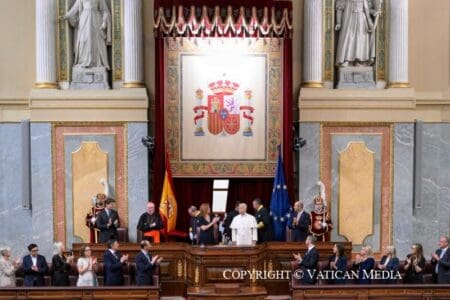
MADRID – Pope Leo XIV delivered a comprehensive pro-life message on Monday in an address to members of the Spanish parliament, urging lawmakers to defend the unborn and the migrant and to opt for peace over war through dialogue free of inflammatory rhetoric.
Speaking at the Congress of Deputies – Spain’s lower legislative house – on June 8, the pope warned against various threats to human dignity and life, saying, the defense of life “is neither a partisan issue nor a confessional interest,” but “a goal of civilization.”
“Every human life must be recognized and safeguarded from conception to its natural end, in every circumstance of its existence,” he said, saying that when this doesn’t happen, “the most vulnerable are the first victims, and the law loses its deepest meaning: to serve and protect every person.”
When pursuit of the common good ceases to be a common pursuit, “public action runs the risk of fragmenting into partial interests, incapable of safeguarding what belongs to all,” he said.
The pope’s visit to Spanish Parliament and his private meeting with Sanchez, which lasted roughly 20 minutes, come as the politician and his party are pushing forward legislation which would enshrine abortion as a constitutional right, similar to the historic precedent set by France in 2024.
Pope Leo addressed Parliament June 8, his third day in Spain, after holding a private meeting with Spanish Prime Minister Pedro Sanchez, a member of the Spanish Socialist Workers’ Party who has served in the role since 2018, earlier that morning.
His 20-minute meeting with Sanchez and the condemnation of abortion he delivered before the Spanish parliament were both significant, as the appeal to respect the unborn comes as Spanish lawmakers led by Sanchez are currently pushing proposed legislation that would enshrine abortion as a constitutional right, much like the historic decision by France to do so in 2024.
Also in attendance at the pope’s meeting were former Prime Ministers Mariano Rajoy and José María Aznarwith.
The pontiff received a nearly 10-minute standing ovation following his speech, in which he also invoked Spain’s history of faith and the country’s role as one of the world’s leading evangelizers, as inspiration for the future.
Cutting across ideological divides
Leo urged the nation and Europe more broadly to renew the Christian roots of their cultural traditions as a path beyond polarization and ideology.
RELATED: Pope in Spain offers road map to future of hope free of ideological divides
Those themes have been strongly present ad running through all the pontiff’s public remarks during his June 6-12 visit to Spain, and were again a key focus of his speech to parliament on Monday.
Leo offered an extended reflection on the nature and purpose of law – which must be at the service of humanity – and on the responsibility of society to defend life in all its stages and conditions.
The pontiff’s remarks cut across political and ideological divides and contained clear messages to both the political left and right.
In his address, Leo said his presence was intended to reinforce a sense of mutual cooperation “in the spirit of service to the human person,” and asked asked lawmakers to ask themselves “what conception of the human person inspires laws, and what kind of society do those laws build?”
Invoking various Spanish literary and religious references, he said the nation “has known how to view the human being as more than just a cog in the social, economic or political order.”
Pope Leo underlined the need to safeguard human dignity while discerning “the moral limits of power,” lamenting that throughout history, “society and the Church herself did not always live up to these insights found in their own Christian tradition.”
“Authority always entails responsibility and that every human being must be recognized as a subject of rights and duties,” he said, saying, “dignity, justice and the common good should be the measure of social relations, both at the national and international levels.”
In addition to his condemnation of abortion, the pope also issued an appeal on behalf of migrants, lamenting that many are forced to leave their homes and families “in search of peace, security, and a future.”
“The tragic drama of migration also challenges the conscience of nations and the ethical foundation of the international order today,” he said, saying the issue encompasses both moral and ethical elements.
Referring to the anti-migrant sentiments present in Europe and throughout the world, Leo said that, “Wherever people are discriminated against because of their national, ethnic, religious or linguistic origin, or because of their economic or social status, the universal principle of the equal dignity of all human beings is seriously violated.”
The situation of migrants and refugees “calls for a response that focuses on people,” and which addresses the underlying causes forcing people to leave, he said, saying handling of the issue “goes beyond the mere management of migratory flows.”
Pope Leo’s message on migration to Spanish lawmakers is especially relevant ahead of his visit to the Canary Islands, which will close out his visit to Spain and which is dedicated almost entirely to the migrant issue, as the pope is slated to meet with migrants themselves and organizations working for their welcome and integration.
In his speech Monday, Leo told parliamentarians that solutions to migrant flows must ensure “safe and legal pathways, a respectful welcome and real opportunities for integration.”
However, it must also work to ensure a person’s right not to migrate, he said, saying no one ought to leave their home “due to a lack of peace, security or decent living conditions, including economic inequalities and the effects of the climate crisis.”
To this end, he lamented that migrants have turned to increasingly dangerous routes in recent years, highlighting the “extremely high cost of this reality, so often hidden or ignored.”
Many migrants fall prey to traffickers and smugglers, he said, calling for greater efforts to “strengthen prevention, rescue and assistance for victims, especially within the framework of regional and multilateral cooperation.”
The migration issue cannot be tackled alone, he said, and urged “a coordinated, supportive, and effective response” from international leaders which guarantees “protection, welcome, and real opportunities for integration to those who migrate.”
“When the institutional response is accessible, just and coordinated, borders cease to be places of abandonment and can become spaces for the responsible protection of human dignity,” he said.
The moral imperative of peacemaking
Pope Leo also spoke of the need to promote peace amid a broad global spiritual and political crisis, “which manifests in multiple forms of violence, polarization and mutual distrust.”
Peacemaking is not only a political aspiration but a “moral imperative,” he said, and called for respectful public and political discourse as well as a commitment to seeking truth and reconciliation.
What is needed, he said, is “a social life capable of sustaining civic friendship and mutual respect amid disagreement.”
“Peace demands diplomatic courage, ethical responsibility and a vision for the future grounded in respect for the identity of every people and in the obligation of States to resolve their disputes through the peaceful means offered by international law,” he said.
Every war is a lamentable example of the failure to negotiate, he said, lamenting that in Europe and throughout the world “rearmament is once again being presented as an almost inevitable response to the fragility of the international situation.”
“True security, however, stems from justice, patient dialogue, respect for international law, and a policy capable of placing the lives of peoples above the interests that profit from war,” the pope said.
He also offered a message on technology and the need for greater ethical oversight amid rapid developments in artificial intelligence, with the good of the human person at the center of policy and decision-making.
In the spirit of promoting peace and unity, Pope Leo pointed to the European Union’s motto, In varietate concordia, meaning “harmony in diversity”, saying “true unity does not standardize, but rather unites in diversity, making cultures, sensibilities, and traditions an opportunity for mutual enrichment.”
To this end, the pope stressed the need to build a culture of reciprocity, saying, “political pluralism should not degenerate into the constant disparagement of one’s adversary.”
“In a mature society, even conflict can