—
As the Church in Africa works to implement Pope Leo XIV’s Encyclical, Magnifica Humanitas, a Catholic Bishop in Cameroon has responded to inquiries regarding the digital landscape, engaging with the principles highlighted in the Pope’s encyclical on social media, and calling for an educated, morally grounded approach to the technological revolution sweeping across the continent.
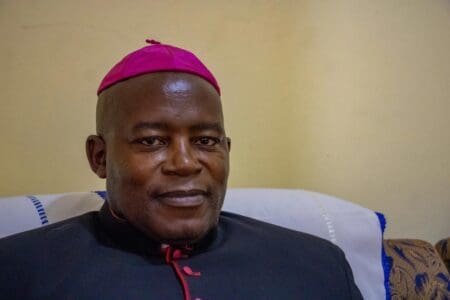
In a wide-ranging interview with Crux Now on the sidelines of the 51st Plenary Assembly of Cameroon Bishops, held recently in Yaoundé, Bishop John Berinyuy Tatah, the Auxiliary Bishop of the Bamenda archdiocese, offers a profound vision that bridges traditional African values and the challenges of the modern world.
He touches on the ethics of Artificial Intelligence, the preservation of the African spirit of Ubuntu, and the exploitation of natural resources.
The bishop also delves into the persistent violence in Cameroon, identifying the root causes not merely as political failure, but as a crisis of the heart that requires internal purification and a return to the common good.
Following are excerpts of that conversation…
Crux Now: The major issue at the 51st General Assembly of the Bishops has to do with peace, and that theme draws from the Holy Father’s words in Cameroon. What do you think Cameroonians as a people need to do to make sure that peace returns to the country?
Berinyuy: I think that the Holy Father came and he sowed the seed of peace, and that seed needs to be watered, it needs to be manured, and it needs to be weeded so that it can grow. The work for that peace to come depends on us.
I think that one of the things that we need to do is first of all purify our hearts. Because if we don’t have inner peace, we cannot give peace outside to other people. And so we need to purify our hearts from bitterness, from revenge, from hatred, and in such a way that we lay down the weapons of violence . Those weapons of violence begin within our hearts; they are not outside. Maybe our words of violence — whatever we transmit, especially in the social media, which has been used as a weapon today — are more powerful even than the physical weapons that we carry.
And so I think that people need to be able to purify their hearts from that bitterness. Then eventually we will be able to lay down the weapons of violence, the language that we use, as well as the physical weapons that we use in order to kill and destroy each other.
That looks more like a moral appeal, but the government can argue that they’ve exhausted almost every avenue for peace, like organizing the Major National Dialogue in 2019. Why is this violence persisting despite those efforts?
I think that this violence is persisting because of the self-interest of people — the self-interest that makes people not think about the common good. If we are thinking about the common good, then we will come down and sit at the table to dialogue with each other, resolve the grievances that we have with each other, come to a compromise, and have a win-win agreement in such a way that we can live together again.
Historically, the church has played a pivotal role in restoring peace in several countries. What can the church in Cameroon do, or what has the church in Cameroon done, in efforts to restore peace?
I think that just the coming of the Holy Father to proclaim the message of peace is part of the work of the church. The Church continues to work, especially to preach the social doctrine of the church, which has ten principles.
The dignity of the human person should be respected. It talks about stewardship, meaning that the things that we have—that God has given us — we need to be able to use them and also think about those who are going to come in the future. We also need to talk about the dignity of human life: human life is sacred, and should not be destroyed. It is only the creator of life that can take away the life of the other person. So, no human being should go ahead to take away the life of others.
Of course, there is the common good, asking that we work together as a family, building up a family. Then each of us will need to participate in building our country—that is the principle of participation. So when we put all those principles together, if we are able to live according to those principles, I think that peace will return and our country will be better.
You touched on this social media issue, which is also one of the issues Pope Leo’s encyclical talks about. How can the African church empower local youth and tech innovators to provide artificial intelligence solutions to daily problems, rather than having Africa remain merely a passive consumer of technology?
I think that there needs to be a lot of education. Of course, Artificial Intelligence, like every other technology comes with positive sides, and it comes with its negative sides. But if we are not educated —because the Bible says that my people perish for lack of knowledge — and if our people are educated on the positive use of this new technology, I think that our continent can advance and Africa can become a better place. We need to know the negative aspects of that technology, which should be avoided, and then the positive sides should be exploited.
One thing that the Pope particularly touched on is resource extraction. How can Africa begin to leverage the resources that it has—which are actually the resources that power this artificial intelligence—to build its economy instead of just exporting the raw material?
I think that that falls back to the principle of stewardship that I was talking about: Taking care of our common environment. Taking care of our common environment means that we use the gifts that God has given us judiciously, thinking about those who are going to come in the future. We cannot exploit everything now and use it without thinking about those who come in the future.
I think that we, too, should be educated in various areas of engineering so that we can become the engineers ourselves who extract our raw material, transform our raw material, and use it to develop our places. Like the crude oil that we have. If we do not have engineers who can refine the oil, other people are going to come and refine the oil from us. When they refine the oil, they will take the better part of it and leave us only with the part which is not useful to us.
What is your greatest fear when you see children at home conversing more with their phones than with their parents? What is the danger for family unity?
I think that with the children discussing mostly with social media, it is going to break up that family spirit that has always been the pride of Africa. Yes, the sense of community, the sense of togetherness, which we have always had, is something that we pride ourselves on. That is the pride of Africa: that we live as a family, we live as a community, that community spirit or Ubuntu: I am because you are, and you are because I am. And so, when we concentrate only on discussing with social media, I think that is going to bring about what Europe is suffering from: individualism. When it promotes the spirit of individualism, that will mean that we’ll be isolated from each other, we’ll not think about each other. And even the biblical commandment that we should love our neighbor like ourselves will not be put into practice.
I think that there is a necessity for us to promote those African cultural values, especially the spirit of the family. The Holy Father came and was talking about the family. We need to strengthen our family. The family is the smallest cell of the society. You even find that in the Blessed Trinity — the Father, the Son, and the Holy Spirit — they live in communion. They live as a family, and we should be able to copy that.
Communication is very, very important: that physical communication with each other, that place where we sit around the fire — the father, the mother, and the children — and discourse about the things that are happening, their stories. I think that we need to recapture those values and bring them up so that we can benefit from them as Africans.
One last question: Across Africa, we’re seeing conflict, strife. The Pope in his encyclical talks about a civilization of love. How can this civilization of love be cultivated across Africa?
Pope Leo is not the only Pope who has spoken about a civilization of love. Pope Paul VI talked about this civilization of love, and Pope Benedict XVI also talked about this civilization of love. It will mean that we should be able to live as people who are ready to forgive each other, people who are ready to let go of some of the hurts that we have received.
If we do that, if we are able to purify our hearts — I go back to the purification of the heart because the purification of the heart is very, very important. You see people doing sports every morning because they want to take care of their physical heart. But there is also what we call the spiritual heart. Nobody seems to take care of their spiri