The post Donald Trump Jr: The Candidate No One Is Talking About appeared first on The American Conservative.
—
Politics
Donald Trump Jr: The Candidate No One Is Talking About
For MAGA, familiarity may matter more than experience.
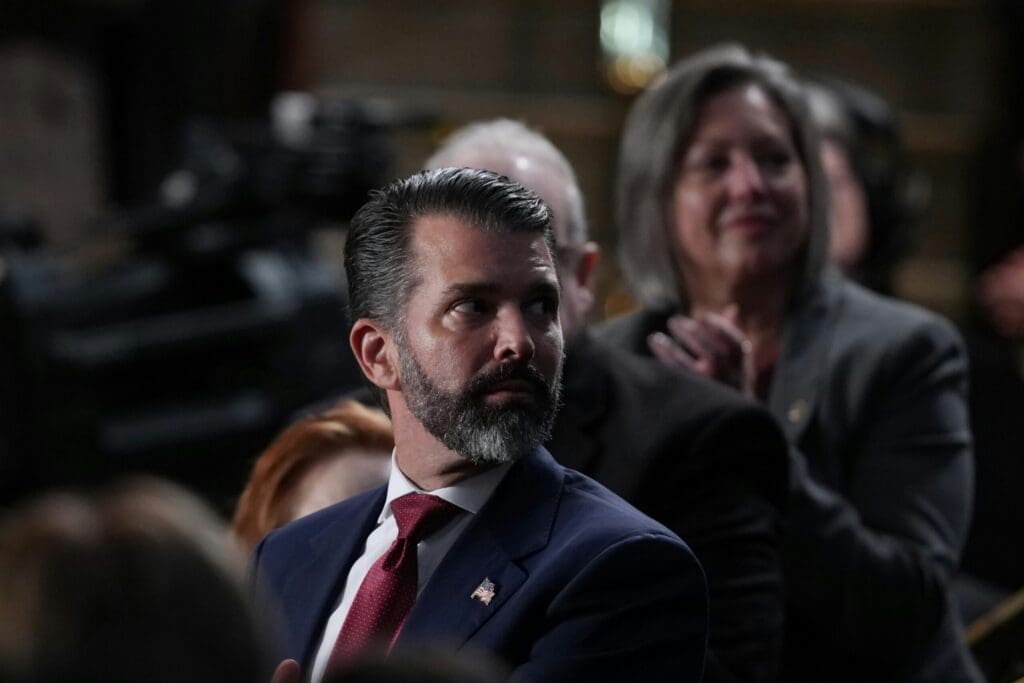
(Photo by Andrew Harnik/Getty Images)
It’s been an interesting 2026, to say the least. The Iran War, which is exposing ideological divisions within MAGA, has brought the American right to an inflection point. A movement that once prided itself on rejecting foreign entanglements is now grappling with their familiar logic. For supporters, that tension raises an uncomfortable question. Was MAGA ever a coherent political doctrine, or was it always something more flexible and more personal?
That distinction matters because it shapes what, and who, comes next. If MAGA is defined more by proximity to President Donald Trump than by principles, succession becomes a question of loyalty, not policy. In that world, the next standard-bearer isn’t the most consistent or experienced but whoever can inherit Trump’s connection to his base. And that is why the most overlooked potential candidate in the 2028 Republican primary field may also be the most obvious: Donald Trump Jr.
The odds-on-favorite, however, is not Don Jr. It’s Vice President J.D. Vance. Seen as the heir apparent, Vance has recently been criticized for remaining silent as the Trump administration’s policy decisions drift from campaign promises. More concerning, Vance has been largely absent from social media during the Iran War. By staying quiet, he’s largely sidestepped his loudest critics on X. That caution may preserve his frontrunner status, but it also exposes a weakness.
In a movement driven by confrontation and authenticity, absence reads less like discipline and more like detachment. Nevertheless, Vance has maintained his status as the clear-cut favorite, earning a 48 percent chance to secure the Republican presidential nominee based on the latest Harvard/Harris poll published on April 26. He also holds the lead on prediction markets such as Polymarket and Kalshi, well ahead of the next contender, Secretary of State Marco Rubio.
Rubio is an intriguing prospect in his own right. Having previously run for president, there is little doubt that Little Marco would jump at the chance to lead the Republican ticket despite public proclamations that the pair have no interest in squaring off against one another. One thing Rubio has going for him is that he has won the admiration of Trump, a surprising turnabout after Trump once mocked the former Florida senator on the campaign trail in 2016. But that’s long in the past now. These days, Rubio looks more like Trump’s right-hand man than Vance does.
When Trump attends UFC events, it’s usually Rubio by his side. When Trump made an appearance at the College Football National Championship in January, it was Rubio smiling with Trump in the press box. Most strikingly, on the first night of the Iran War, Vance and National Intelligence Director Tulsi Gabbard were in a Washington, DC situation room. Rubio, by contrast, was seated next to Trump in a makeshift command center at Mar-a-Lago.
All of which explains why Rubio’s stock, which once appeared nonexistent, has shot up in the betting markets and also in recent polling data. And though Trump could put the entire question to bed with a single Truth post, the president has remained coy when asked who should lead the ticket in 2028, arguing that either man would make a fine candidate. Trump’s reluctance partly reflects his stated (if joking) interest in running again, encouraged by allies such as Steve Bannon. More likely, Trump hasn’t chosen a successor because the pick will define his legacy. Getting the pick wrong could render MAGA a flash-in-the-pan movement instead of the historical upheaval that he and his supporters view it to be.
Perhaps the most intriguing prospect left unnamed is Florida Gov. Ron DeSantis, the man whose governance has most closely mirrored the stated promises of MAGA. Sure, DeSantis is an Israel hawk, but who isn’t in Trump’s own administration? And despite his affinity for the state of Israel, DeSantis has been strong on domestic policy. He fought Covid restrictions, pushed aggressive immigration enforcement at the state level, and, perhaps most importantly, engaged in high-profile confrontations with major corporations over cultural and political issues. And on artificial intelligence, something voters are increasingly concerned about, DeSantis has been fantastic, correctly pointing out that Americans should be wary of handing over their futures to the corporate class in Silicon Valley.
But no matter how strongly he has governed, should DeSantis run again in 2028, he is probably destined to suffer the same fate he did in 2024 when he clashed with Trump on the campaign trail. His lack of aura and his reluctance to get his hands dirty in a movement built in the trenches remind MAGA voters more of the Bush-era GOP than the brand Trump built. Interestingly, DeSantis illustrates a broader dynamic that will not only shape the 2028 primary field but the MAGA movement to come, in which executing the agenda of MAGA is not the same as embodying the cultural instincts of the movement. In a political climate where identity outweighs policy, that gap may hurt the ambitions of MAGA’s most prominent elected politician outside Trump.
If the 2028 nominee field is defined by proximity to Trump and personal charisma, there is one other figure worth considering before returning to Don Jr: Tucker Carlson. While Carlson shows some movement in the markets and retains credibility with disaffected MAGA voters, his recent distancing from the administration and his combative ideological purity make him a movement commentator rather than a movement candidate. That leaves one potential candidate we have yet to fully consider: Donald Trump Jr.
In April polling conducted by YouGov, Trump fils proves he is a viable candidate. Thirty-one percent of respondents said they would consider voting for Don Jr., while another 13 percent named Trump’s son as their “ideal choice.” Though 13 percent may seem modest, it was the second-highest number behind Vance, who scored 36 percent on the question. When asked who they believed was most likely to win the presidency if nominated, Don Jr. was the second choice behind Vance. And most notably, Don Jr. performs best with voters aged 18–29, while struggling with those over 65. That signals something important; for many young Republicans, Don Jr. is undoubtedly seen as a figure for the future.
Then there is the Harvard/Harris poll released in late April which shows Trump Jr. at 18 percent support in a potential 2028 primary race. That figure is two points higher than Rubio but markedly behind Vance who earned 48 percent support. In another April poll, conducted by McLaughlin, the younger Trump netted 15 percent. He hasn’t declared a run, but the polling shows a real base to build on. Of course, whether he believes it is the right time or is willing to scuttle his friendship with Vance is another question altogether.
But the world of politics is fraught with backstabbing and disharmony. Though Don Jr. helped Vance secure the vice presidency in 2024, that doesn’t mean he’ll step aside if he fears a loss could damage his father’s legacy. And Don Jr. has something Vance will never possess: the name, the brand, and the instincts that made his father a generational political figure. No one else in the field can claim that.
In the end, the question facing MAGA is not simply who can carry Trump’s agenda forward, but who can embody the man himself. If the answer is rooted less in policy than in identity, loyalty, and instinct, then Donald Trump Jr. is much more than a dark horse. He is a logical extension. And in a primary likely to be defined by Trump, that proximity may matter more than anything else.
The post Donald Trump Jr: The Candidate No One Is Talking About appeared first on The American Conservative.