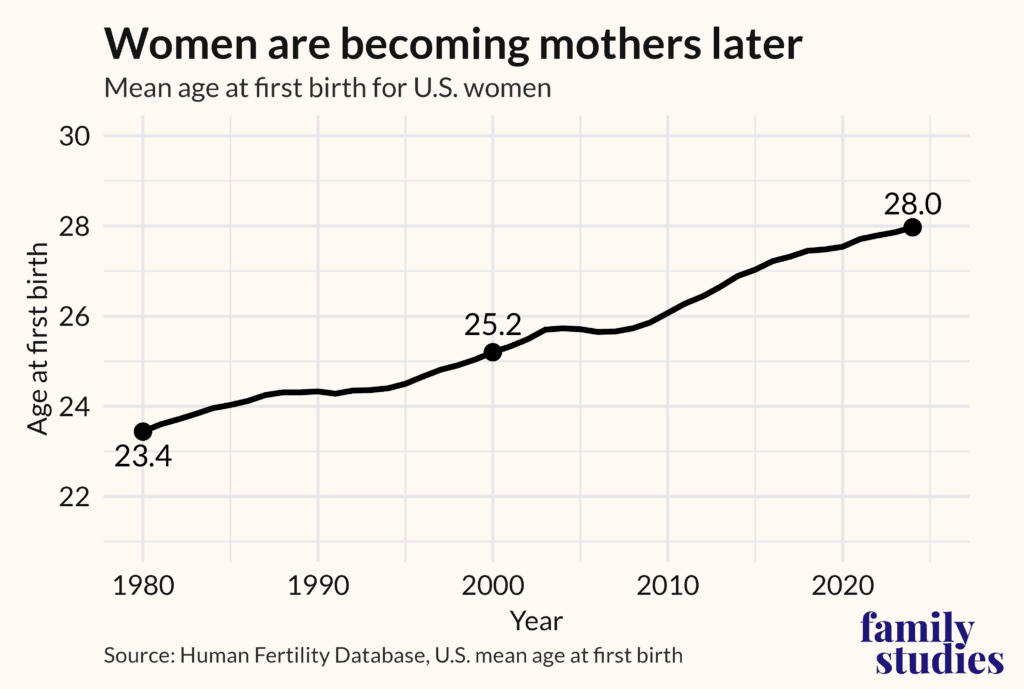
For years, falling fertility rates were plausibly interpreted as evidence that Americans were postponing parenthood. New data on first births suggest something far more concerning: more women may never become mothers at all.
The total fertility rate (TFR)—which estimates how many children a woman would have in her lifetime if current birth rates persisted—recently fell to 1.6 births per woman. This decline has prompted growing attention to the social and economic implications of low fertility—including speculation that more women may reach the end of their reproductive years without ever becoming mothers.
But broad measures like the total fertility rate can mask important differences across age groups and birth orders. While fertility rates to women under age 30 have declined for years, fertility rates among women in their 30s have increased for decades. That pattern led some researchers to suggest that women were delaying—rather than foregoing—motherhood.
This “delayed motherhood” hypothesis squares with much historical data. Whether delayed childbearing ultimately leads to higher levels of childlessness depends on social, economic, and institutional conditions. Rising ages at childbirth do not necessarily translate into more women remaining childless.
Indeed, until recently in the U.S., the opposite appeared to be true. Between 2000 and 2019, the percentage of women reaching age 45 who became mothers rose from 85% to 91 percent.1 Delayed childbearing coincided with a higher proportion of women who became mothers.
Yet overall fertility rates—even when examined by age—still obscure an important factor to understanding what will likely happen to rates of ultimate childlessness among current cohorts of young women. Births to older mothers are more likely to be second or higher-order births. In 2024, for example, more than 70% of births to women over age 30 were second or higher-order births. As a result, the generic fertility rates to women in their 30s and 40s tell us more about family expansion than about entry into motherhood.
To better understand whether more women are likely to remain childless, it is important to examine the first birth rate—the rate at which women become mothers for the first time. For decades, declines in first birth rates among women in their teens and 20s were offset by rising first birth rates among women in their 30s. More women were entering motherhood later in life, and those increases offset fewer women becoming mothers at younger ages. That shift contributed to the stable, even rising, share of women who eventually had children, even as the age at first birth rose.
But recent trends look different.
First birth rates among women in their early 30s have been declining since 2007. For women in their late 30s, first birth rates have been falling since 2014. Meanwhile, since 2015, the rate in which childless women became mothers at age 30 has fallen by 33%, while the rate in which childless women became mothers at age 40 has fallen by 13 percent.
If women were merely delaying motherhood, we would expect first birth rates among such women to be rising. Instead, entry into motherhood is falling across nearly every age, with negligible increases among women in their mid-to-late 40s. First births to women in their late 40s remain almost non-existent—fewer than 3 out of every 1,000 childless women become mothers in a given year.
The “delayed motherhood” hypothesis held strong in earlier generations of American women. For those cohorts, declines in first births to women in their 20s were more than offset by women becoming mothers in their 30s, and the percentage of women who became a mother increased.
But examining the underlying first birth rates shows that current levels of motherhood will likely not be sustained. The first signs are already visible among the women currently aging out of their reproductive years. In the past five years, completed entry into motherhood—the share of women who became mothers by the end of their childbearing years—has fallen by two percentage points.
This two-percentage-point decline may appear modest, but changes in first birth rates among younger women point to a larger decline ahead. Lyman Stone, senior fellow at IFS, predicts that 1-in-4 women will not become mothers in the future. This projection is plausible: holding today’s first birth rates constant, we get similar results. If current first birth rates persist, lifetime childlessness will rise toward 25 percent.
Holding rates constant is a conservative estimate. As shown above, conditional first birth rates are falling for nearly every age group. There is no evidence so far suggesting that later-age births will make up for the declines we are witnessing today.
That means we are likely witnessing peak motherhood today. First birth rate trends suggest the share of women who will become mothers will fall with each cohort. While many women are delaying motherhood, a growing share will never become mothers at all.
Grant Bailey is Deputy Director of the Get Married Initiative and Insights Editor at the Institute for Family Studies. Anne Morse holds a PhD in Demography and Sociology.
1. These estimates are drawn from cumulating cohort age-specific first birth rates. Survey estimates tend to give lower estimates.
—
by Grant Bailey (@grantjbailey) and Anne Morse (@Anne_red_head)
For years, falling fertility rates were plausibly interpreted as evidence that Americans were postponing parenthood. New data on first births suggest something far more concerning: more women may never become mothers at all.
The total fertility rate (TFR)—which estimates how many children a woman would have in her lifetime if current birth rates persisted—recently fell to 1.6 births per woman. This decline has prompted growing attention to the social and economic implications of low fertility—including speculation that more women may reach the end of their reproductive years without ever becoming mothers.
But broad measures like the total fertility rate can mask important differences across age groups and birth orders. While fertility rates to women under age 30 have declined for years, fertility rates among women in their 30s have increased for decades. That pattern led some researchers to suggest that women were delaying—rather than foregoing—motherhood.
This “delayed motherhood” hypothesis squares with much historical data. Whether delayed childbearing ultimately leads to higher levels of childlessness depends on social, economic, and institutional conditions. Rising ages at childbirth do not necessarily translate into more women remaining childless.
Indeed, until recently in the U.S., the opposite appeared to be true. Between 2000 and 2019, the percentage of women reaching age 45 who became mothers rose from 85% to 91 percent.1 Delayed childbearing coincided with a higher proportion of women who became mothers.
Yet overall fertility rates—even when examined by age—still obscure an important factor to understanding what will likely happen to rates of ultimate childlessness among current cohorts of young women. Births to older mothers are more likely to be second or higher-order births. In 2024, for example, more than 70% of births to women over age 30 were second or higher-order births. As a result, the generic fertility rates to women in their 30s and 40s tell us more about family expansion than about entry into motherhood.
To better understand whether more women are likely to remain childless, it is important to examine the first birth rate—the rate at which women become mothers for the first time. For decades, declines in first birth rates among women in their teens and 20s were offset by rising first birth rates among women in their 30s. More women were entering motherhood later in life, and those increases offset fewer women becoming mothers at younger ages. That shift contributed to the stable, even rising, share of women who eventually had children, even as the age at first birth rose.
But recent trends look different.
First birth rates among women in their early 30s have been declining since 2007. For women in their late 30s, first birth rates have been falling since 2014. Meanwhile, since 2015, the rate in which childless women became mothers at age 30 has fallen by 33%, while the rate in which childless women became mothers at age 40 has fallen by 13 percent.
If women were merely delaying motherhood, we would expect first birth rates among such women to be rising. Instead, entry into motherhood is falling across nearly every age, with negligible increases among women in their mid-to-late 40s. First births to women in their late 40s remain almost non-existent—fewer than 3 out of every 1,000 childless women become mothers in a given year.
The “delayed motherhood” hypothesis held strong in earlier generations of American women. For those cohorts, declines in first births to women in their 20s were m